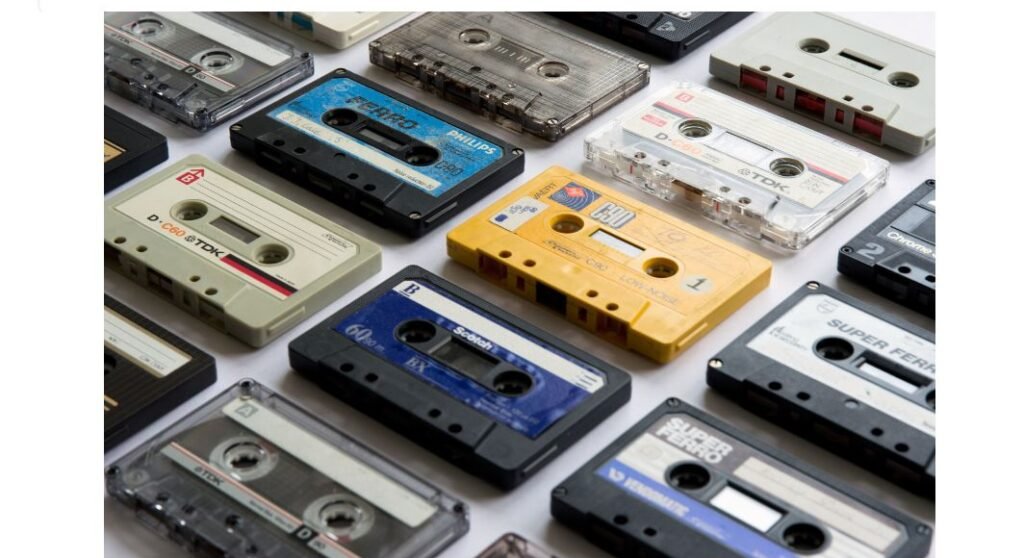
Introduced in 1963 by Dutch company, Phillips, the compact cassette tape pretty much changed the way we listened to music.It was the most portable audio media and by the mid-70s a car was considered incomplete without an in-dash cassette player. They rose in popularity until the 1990s with the compact discs (CDs) being introduced. Much have changed since then, but there are still a few hard-core fans of the cassettes that take us on a trip down their memory lanes.
Remember the good ol’ audio cassette: the audio media with its 120 minutes of data that ruled the music scene for decades and symbolised the pop culture? ‘Tape lagao’ (put the tape on) is a phrase that many of us who grew up in the ‘80s and ‘90s are familiar with. We would rush to the market and empty our pocket money on cassettes sacrificing the ice-cream or cola for them. And all hell would break loose when a record would get stuck in the roller and a pencil would come in handy to spool the cassette.
Assam’s Meghna Dutta remembers the magical ‘90s, sitting on the couch with her besties, immersed in music blowing from the stereo, “Like every teenage girl, we were diehard fans of Boyzone. I listened to all ‘90s pop hits like MLTR, Savage Garden and Britney Spears as well as Alisha Chinai, Silk Route and Euphoria. I remember buying audio cassettes for around 60 to 70 rupees.” She says her mum was generous enough to fork out money for her cassette purchases and she memorised the songs as they ran on the player. Agrees 25-year-old Sneha Bhat from Mumbai, “As a ‘90s kid, cassettes held an important place in our hearts and homes. We still have a drawer filled with cassettes and our home wouldn’t feel like home without songs playing from the stereo.”
Software engineer, Kashmira Patel, who grew up in Maharashtra, and now resides in California, remembers countless road trips where the journey began early in the morning with an aarti (ritual of worship) cassette. Packing involved picking out favourite tapes and the entire trip would have four young girls singing along with the songs on the tape.
She now wonders how her parents and the driver sat through that ruckus. She fondly remembers how, after moving to California, her then colleague, and now husband, tempted her to go visit him to listen to “stacks and stacks of lovely Hindi cassettes”. His lure worked for sure. From Onida to Philips, from the Boombox to the walkman, the tape era witnessed the listening of songs in a charming way unlike today. Sneha remembers, “Rewind, check, more rewind and forward…..it was a luxury at a time when money was pretty limited.”
A huge fan of Sonu Nigam, she remembers her first buy, Tu (it had the song by the same name that took the nation by storm). “I was madly in love with Sonu and did not hesitate to buy it at a time when a single piece would cost 40 rupees.” Fashion designer and blogger Garima Srivastava Nag says she would love to relive the ‘90s, “My parents had around 500 plus cassettes and I still miss those days when they were like luxuries, unlike today where everything is available at the click of a mouse. We would make a list of our favourite songs and get them recorded on fresh tapes.”
If you think the present generation is alien to the joy of cassettes (where the smart phones and downloads make music a sundry affair), think again. Pune-based Bhakti has a treasure trove of 75 cassettes, “My kindergarten played nursery rhymes during play time and at home I remember having a cassette compilation of nursery rhymes, forcing everyone around me to listen every time I was bored. I still have that cassette!” Weren’t cassettes also the perfect birthday gift one could dream of getting in those days? Meghna beams, “Indeed, it was! The joy of bringing home a cassette, the ‘sacred act’ of taking off the thin plastic transparent wrapper, readying the tape recorder/stereo and finally playing the cassette was quite something.”
Sneha recalls, “We didn’t get any pocket money so my sister and I had a clear strategy – we would buy cassettes provided 90% of the songs in them were good. Besides those, we would spend our afternoons writing popular songs on paper and sharing with our local ‘bhaiya’ (shopkeeper) who recorded the songs on a fresh cassette. We gave these cassettes cheesy names such as, ‘Superhits-Vol1’, ‘Ehsaas’ and ‘Dil Ki Baat’. We had a pact with our cousins and friends too and we would hold meetings before buying cassettes; if we bought Josh, our cousins had to buy Jaanam Samjha Karo so that we could exchange it when need be. Simple and cheap.”
She rues the fact that cassettes vanished from the scene suddenly, with the advent of MP3, iPod and Bluetooth.
Can the priceless Walkman be left behind for a generation who lapped cassettes for a whole decade? Meghna recounts, “When I grew up, I was still stuck on cassettes despite the fact that CDs had flooded the market. I was the first amongst my friends to get a Walkman and it was pretty cool!” For Bhakti, carrying one’s favourite cassettes and extra batteries was akin to packing luggage during exhausting train journeys. “Who can beat the Walkman?” she argues. “The Walkman was used in turns – all songs playing from Side A soon made the shift to Side B. The bond I had with my Walkman could not be emulated with MP3s and iPods.”
She adds. “Not having enjoyed the charm of cassettes is like being deprived of the joy of something like Malgudi Days. It is, in itself, tragic.” Meghna adds, “During our time, choices were limited and if the cassette of an old movie reached its life span, that’s it. No Google search, no Apple store or no internet to download. There was no way we could retrieve it.”
What if the vintage cassette were to make a comeback? Bhakti says, “The old cassette still appeals to me.” Meghna agrees, “I better get my cassette player ready to be back in action!”